You’ve heard that NPS is the gold standard for measuring customer loyalty. Your board wants a number. Your product team wants feedback. But when you sit down to actually run an NPS survey, you realize nobody’s told you the practical how, the timing, the question wording, what to do with a score of 32.
The good news: an effective NPS survey doesn’t require expensive software or a data science team. It requires a clear plan, a few well-chosen questions, and the discipline to actually act on what you learn.
A quick refresher on NPS scoring
Net Promoter Score measures loyalty with one question: “How likely are you to recommend us to a friend or colleague?” Respondents answer on a 0-10 scale, and their answers sort them into three groups:
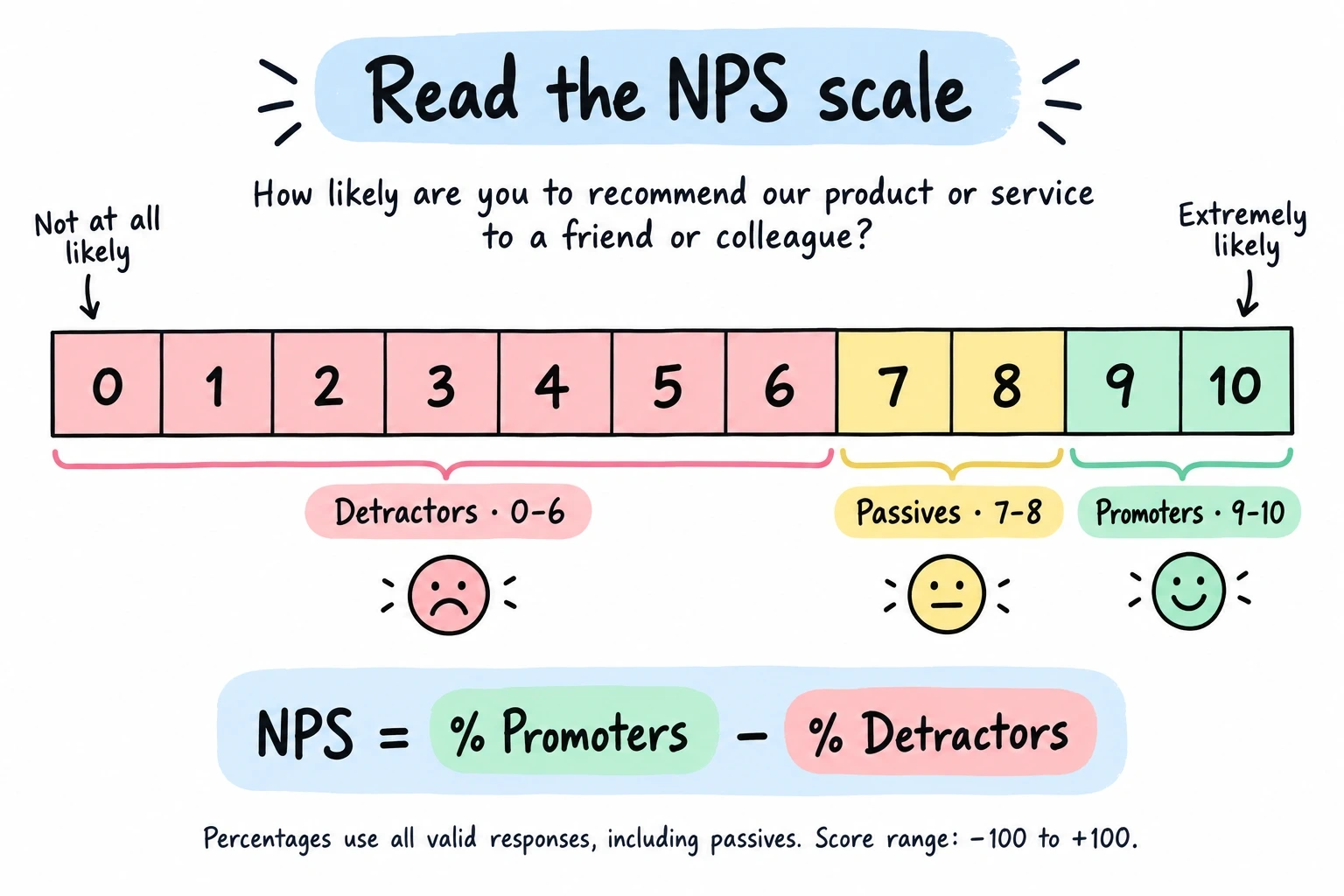
- Promoters (9-10): Loyal fans who actively refer you
- Passives (7-8): Satisfied but not enthusiastic, vulnerable to competitors
- Detractors (0-6): Unhappy customers who may discourage others
Using Bain’s NPS calculation, your NPS = % Promoters minus % Detractors. Scores range from -100 to +100. Anything above 0 means more promoters than detractors. Above 50 is strong. Above 70 is world-class. Once the responses are in, our free NPS calculator does the math and shows how your score compares to benchmarks.
Bain & Company’s research shows that companies with high NPS scores grow roughly 2.5x faster than competitors. That stat gets thrown around a lot, but the mechanism is straightforward: happy customers buy more, stay longer, and bring friends.
Pick your NPS type and set a goal
Not all NPS surveys measure the same thing. Pick the type that matches your goal before you design anything.
| NPS Type | What it measures | When to send | Frequency | |---|---|---| | Relationship NPS | Overall brand loyalty | Any time | Quarterly or biannually | | Transactional NPS | Satisfaction with a specific interaction | Within 24-48 hours of the event | After each interaction | | Competitive NPS | How you stack up against alternatives | Periodic benchmarking | Annually |
Set a realistic response rate target. Email NPS surveys typically get 10-30% responses. In-app surveys land around 5-15%. Plan your sample size to get at least 100 completed responses — that’s roughly where the data starts being statistically useful.
For timing, avoid holidays and crunch periods. B2B surveys perform best Tuesday through Thursday. B2C depends on your audience, but weekday mornings tend to outperform weekends.
Choose how to distribute your survey
Your distribution channel shapes both your response rate and the quality of feedback you get back.
Still the most common channel for NPS. Works well for relationship surveys and reaching customers who aren’t actively in your product.
Keep the email short. Use a subject line like “Quick question about [Company Name]” because specificity beats cleverness. If possible, embed the NPS scale directly in the email body so people can click a score without loading a separate page.
In-app
Best for software companies running transactional NPS. You catch people while the product experience is fresh.
Trigger it after positive moments: a completed task, a feature discovery, a successful export. Don’t trigger it after errors or failed actions. Use a slide-in panel or modal that’s easy to dismiss.
Website embeds and popups
Good for capturing feedback from prospects and new customers. Use exit-intent triggers to avoid interrupting active browsing. Target specific pages relevant to what you’re measuring.
SMS
Higher open rates than email for mobile-first audiences. Keep the message under 160 characters and only survey people who’ve opted into SMS. Include a clear opt-out.
Write your NPS survey questions
The core question is standardized, but your follow-up questions determine whether you get actionable feedback or just a number.
The core question
Use the standard wording: “How likely are you to recommend [Company/Product] to a friend or colleague?”
Display the 0-10 scale with clear labels. Most people know the format, but labels help prevent misinterpretation.
Follow-up questions that actually help
The score alone tells you the temperature. The follow-up tells you why.
For everyone: “What’s the primary reason for your score?” This single open-ended question is where 80% of your actionable insights come from. Make it optional to protect completion rates, but most people will answer.
For detractors (0-6): “What’s the most important thing we could do to improve?” This focuses detractors on solutions rather than letting them vent. It also shows you take their feedback seriously.
For promoters (9-10): “What do you value most about [Product]?” Understanding what drives loyalty helps you protect and amplify your strengths.
Keep demographic questions minimal
If you need to segment results, add 1-2 demographic questions at most: customer tenure, company size, usage frequency. Every question beyond that costs completions. Only ask what you’ll actually use in analysis.
Build and brand your survey
A professional-looking survey gets more completions than a bare-bones one. People judge credibility by appearance, even for a two-question form.
Design essentials:
- Clean layout with generous white space
- Your logo and brand colors for recognition
- Mobile-friendly layout (over 50% of survey responses come from phones)
- Clear navigation if you’re using multiple pages
- A progress indicator, even if it’s just “Question 1 of 3”
Technical setup to get right:
- Response tracking so you can see where people drop off
- Data export to CSV or your analytics tool
- Custom domain for the survey URL if credibility matters to your audience
Fomr handles all of this on the free plan: unlimited responses, 1,700+ fonts, full brand customization, and forms that work on any device. It’s one of the simplest ways to build an NPS survey that doesn’t look generic.
Launch smart, not fast
Resist the urge to blast your entire list on day one.
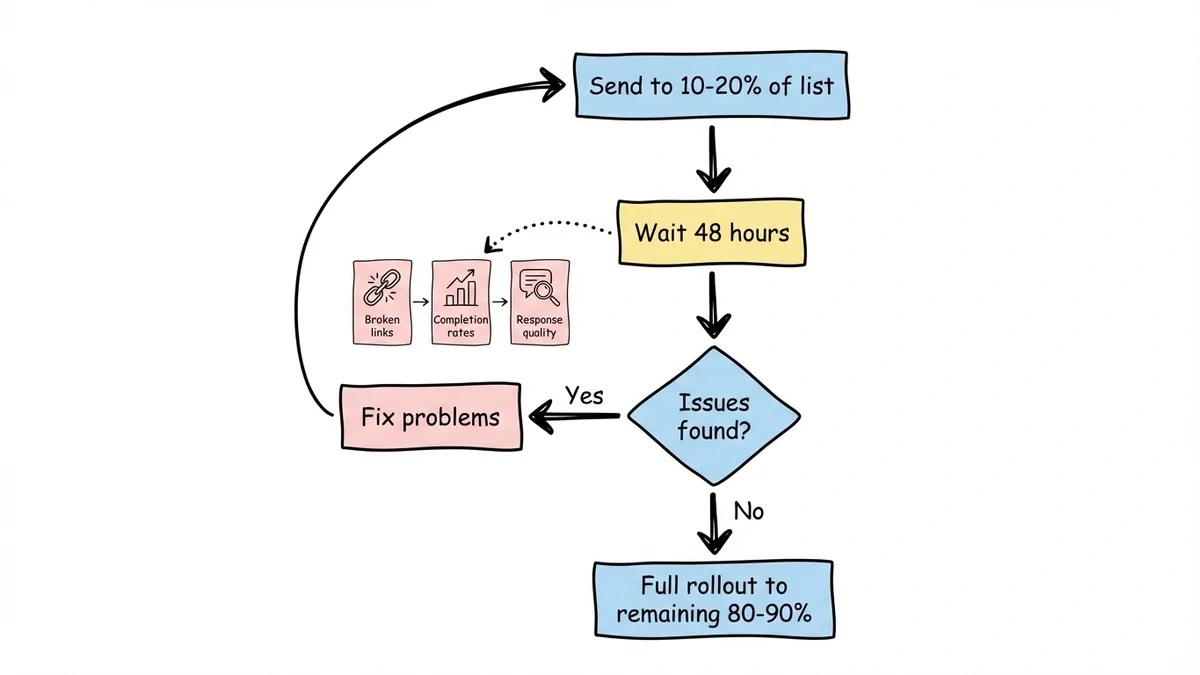
Soft launch first. Send to 10-20% of your list and wait 48 hours. Check for broken links, confusing questions, or unexpectedly low completion rates. Fix issues before the full rollout.
Personalize where you can. Use the customer’s name. Reference the specific product or plan they’re on. Generic surveys feel like bulk mail.
Set expectations in the invite. Tell people how long the survey takes (“30 seconds”) and what you’ll do with their feedback (“help us improve the product”). Both increase response rates.
Here’s a sample email that works:
Subject: Quick question about [Company Name]
Hi [First Name],
We're working on improving [Product Name] and your perspective would help.Could you answer one quick question? It takes about 30 seconds.
[Survey Link]
Thanks,[Your Name]
Short, specific, respectful of their time.
Monitor and adjust early
The first 72 hours tell you a lot about how your survey is performing.
Track these numbers:
- Response rate: (completed surveys / invitations sent) x 100. Target 15-20% for email.
- Completion rate: % of people who started the survey and finished it. Should be above 85%. If it’s lower, your survey is too long or confusing.
- Time to complete: if it’s over 2 minutes, cut something.
- Device split: if mobile completion is significantly lower than desktop, your form has a responsiveness problem.
If response rates are low:
- Send a reminder after 3-5 days. Keep it brief: “Just checking if you had 30 seconds for our question.”
- Test a different subject line.
- Try a different send time.
- Remove any optional questions to shorten the survey.
Analyze beyond the number
A raw NPS score is a starting point, not a destination. The real value is in the patterns.
Calculate your score
- Count promoters (9-10), passives (7-8), and detractors (0-6)
- Calculate % promoters and % detractors
- NPS = % promoters - % detractors
Segment your results
Don’t stop at the overall number. Break it down by:
- Customer tenure, because new customers often score differently than long-term ones
- Product tier, since free vs. paid users may have different expectations
- Region, where cultural differences affect NPS norms
- Support history, because customers with recent tickets may skew lower
These segments often reveal that your “average” NPS hides two very different stories.
Read the open-ended responses
The qualitative feedback is usually more valuable than the score. Look for:
- Recurring themes: if 15 detractors mention the same issue, that’s your priority
- Specific suggestions from detractors, who often tell you exactly what to fix
- What promoters love, so you can protect those things
- Competitor mentions, which are free market intelligence
Close the loop (this is where most companies fail)
Collecting feedback and doing nothing with it is worse than not asking. It trains customers to ignore your future surveys.
Quick wins (first week)
Respond to detractors within 48 hours. Acknowledge their experience, apologize where warranted, and tell them what you’re doing about it. This single action can convert detractors into passives or even promoters.
Thank your promoters. A short personal note goes a long way. Consider asking if they’d be open to leaving a review or participating in a case study.
Flag urgent issues. If multiple respondents mention the same critical problem, escalate it immediately.
Long-term actions
Feed NPS insights into your product roadmap. Share results across teams so customer success, product, marketing, and sales all understand sentiment patterns. Run a follow-up survey with the same group 3-6 months later to measure whether your changes made a difference.
Common NPS mistakes (and how to avoid them)
Asking too many questions. The ideal NPS survey has 2-4 questions. Every question beyond the core NPS question reduces completion rates.
Surveying too often. Quarterly is fine for relationship NPS. Monthly annoys people and tanks your response rate.
Ignoring passives. Passives (7-8) are your biggest opportunity. They’re satisfied enough to stay but not loyal enough to recommend you. Small improvements can push them into promoter territory.
Obsessing over the number. An NPS of 42 means nothing without understanding why it’s 42. A score that drops from 50 to 40 with clear reasons is more useful than a steady 50 with no qualitative data.
Surveying too early. Customers who signed up last week don’t have enough experience to give meaningful feedback. Wait until they’ve had time to form a real opinion, typically 30-90 days.
Build your NPS program for the long run
The companies that get the most from NPS treat it as an ongoing program, not a one-time project. Survey regularly, track trends over time, share results broadly, and always close the loop with respondents.
When customers see their feedback actually change things, they respond to your next survey at higher rates. That cycle works, but only if you do the work after collecting the scores.
Ready to set up your first NPS survey? Fomr’s guest editor lets you build a professional, branded survey in minutes, no account required, no response limits on the free plan.