Most people searching for an open source form builder don’t actually want source code. They want one of three things: control over their data, an escape from per-response billing, or insurance against a vendor tripling prices next year. Those are all reasonable. But they lead to different tools, and “open source” alone won’t sort them for you.
One thing before the list: Fomr is not open source and can’t be self-hosted. We’re on this page because a lot of people who type this search are really looking for unlimited free responses without running a server, and we cover that case at the end. If your requirement is genuinely self-hosting, the six tools below are the real answer, and we’ve priced out what each one costs to run.
What self-hosting an open source form builder actually costs
The software is free. The operation isn’t.
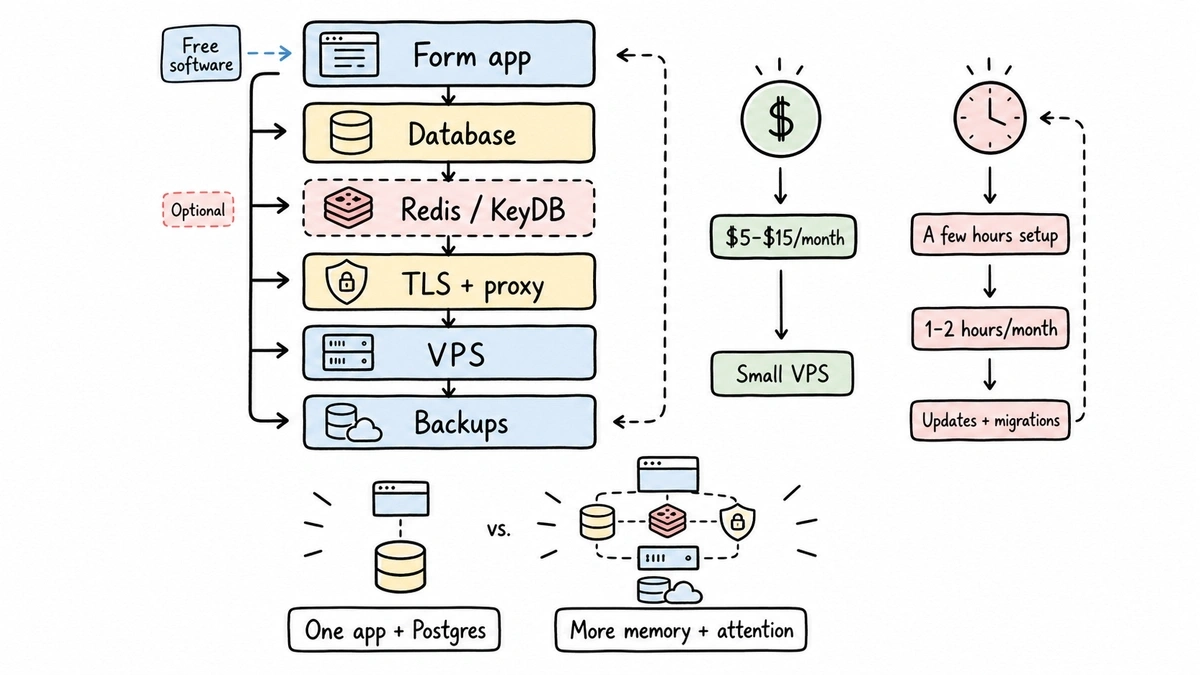
Every tool on this list needs a server, a database, TLS certificates, backups, and someone who applies updates. A light stack (one app container plus Postgres) runs comfortably on a small VPS in the $5 to $15 a month range. Heavier stacks with multiple services want more memory and more attention.
The bigger cost is time. Budget a few hours for initial setup, then an hour or two a month for updates and the occasional broken migration. If your time bills at anything, a $100-a-year cloud plan often beats a “free” self-hosted instance. None of the six projects publishes official hardware minimums, so the honest sizing guide is the stack itself: count the containers.
One more thing to check before you commit: the licence. Two tools on this list are not plain open source. Typebot uses the Functional Source License, which converts to Apache 2.0 after two years but restricts commercial hosting in the meantime. And most “open source” form builders are open-core, meaning an enterprise folder in the repo sits under a separate proprietary licence.
The 6 best open source form builders, compared
All prices and limits below were checked against each vendor’s live pricing page and GitHub repo on August 8, 2026.
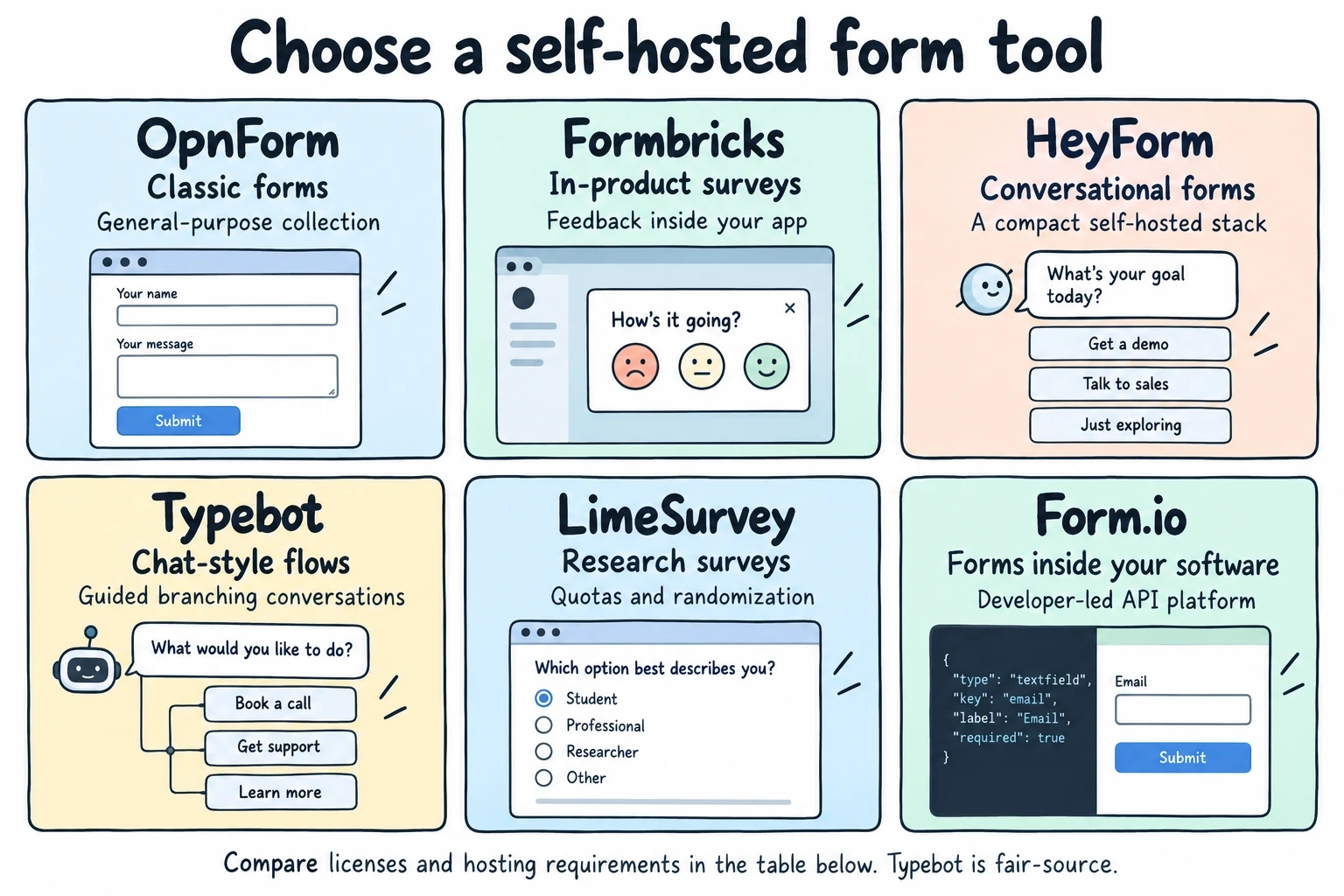
| Tool | Licence | Stack you host | Cloud free tier | First paid cloud tier |
|---|---|---|---|---|
| OpnForm | AGPLv3 (open-core) | Docker, Postgres, Redis | Unlimited forms and submissions | Pro, $25/mo |
| Formbricks | AGPLv3 (open-core) | Postgres, Redis, 3+ services | 250 responses/mo | Pro, $74/mo |
| HeyForm | AGPL-3.0 | Docker, MongoDB, KeyDB | None (7-day trial) | Basic, $15/mo |
| Typebot | FSL-1.1 (fair-source) | 2 Next.js apps, Postgres | 200 chats/mo | Starter, $39/mo |
| LimeSurvey | GPLv2+ | PHP server, MySQL or Postgres | 25 responses/mo | Basic, 26 EUR/mo |
| Form.io | OSL-3.0 | Node.js, MongoDB | None (30-day trial) | SaaS, $300/mo |
1. OpnForm — best overall for classic forms
If “form builder” means what it usually means (fields on a page, submissions in a database), OpnForm is the strongest general pick. It’s a Laravel and Nuxt app with a clean editor, file uploads, logic, and webhooks, licensed AGPLv3 with only its Enterprise directory under a separate licence. Around 3,500 GitHub stars, and it ships steadily: v2.2.4 landed in late July 2026.
Self-hosting is a Docker Compose setup with Postgres and Redis. Forms and submissions are unlimited on your own instance.
The catch, and it’s a real one: a free self-hosted instance is capped at 2 users. More seats, SSO, and branding removal require a self-hosted enterprise licence at $1,999 a year. For a solo founder or a two-person team that’s irrelevant. For a ten-person team, it changes the math completely.
The cloud version is generous too: the free tier has unlimited forms and submissions with OpnForm branding, and Pro is $25 a month.
Honest limitation: the 2-user self-hosted cap, and a smaller community than the bigger names here, so fewer answered questions when something breaks.
2. Formbricks — best for in-product surveys
Formbricks is the most popular project on this list at roughly 12,700 stars, and the most actively developed (a release two days before we checked). But know what it is: an experience-management tool, a self-hosted Qualtrics. It shines at in-app micro-surveys, NPS, and targeting users by behavior. It’s overkill for a contact form.
The self-hosting story has gotten heavier. The Docker Compose stack now deploys Postgres, Redis or Valkey, the web app, a hub service, and Cube for analytics, and the optional AI features want a GPU host. This is no longer a weekend VPS project.
Cloud pricing reflects the enterprise lean: free covers 250 responses a month, and the first paid tier is Pro at $74 a month for 2,000 responses. That jump from free to $74 is steep if you’re a small team.
Honest limitation: survey-first, not form-first, and the multi-service stack makes it one of the more expensive tools here to operate yourself.
3. HeyForm — the budget cloud pick
HeyForm is a straightforward conversational-and-classic form builder under a clean AGPL-3.0 licence, no enterprise folder asterisk. It had a big v3.0.0 release in early August 2026, so concerns about maintenance are settled for now. About 8,900 stars.
Self-hosting means three containers (the app, MongoDB, and KeyDB) plus your own reverse proxy for TLS. If your infrastructure standardizes on Postgres, the MongoDB dependency is a mild annoyance.
The cloud side is the twist. There’s no free tier at all, just a 7-day trial. But the first paid tier is the cheapest on this list: Basic at $15 a month for 5,000 responses. If you were going to pay anyway, that undercuts everyone.
Honest limitation: no free cloud tier, and a smaller integration ecosystem than the commercial SaaS players.
4. Typebot — the specialist pick for conversational forms
Typebot builds chat-style flows: one question at a time, with branching, variables, and API calls between steps. For lead qualification or guided intake it’s excellent, and at around 10,200 stars it has a healthy community. Self-hosting means two Next.js apps (builder and viewer) plus any Postgres database.
Two things to weigh. First, the licence changed from AGPL to FSL-1.1, which forbids selling access to your instance or offering Typebot hosting as a service; each release only becomes Apache 2.0 two years after publication. For internal company use this changes nothing. For an agency reselling hosted forms, it does.
Second, cloud pricing is usage-based with monthly billing only: free covers 200 chats a month, Starter is $39 a month for 2,000 chats, and overages run $10 per 500. A viral form can produce a surprising bill.
Honest limitation: chat format only. If you need a classic multi-field page, this is the wrong tool, full stop.
5. LimeSurvey — research-grade surveys on boring, stable tech
LimeSurvey has been around since 2003, and it’s still the tool academics reach for: quotas, complex conditions, randomization, and export formats built for statistics software. GPLv2, actively maintained, and the easiest thing here to host in one sense, because it’s a classic PHP app. Any PHP 8.1+ web server with MySQL or Postgres runs it. No Docker knowledge required.
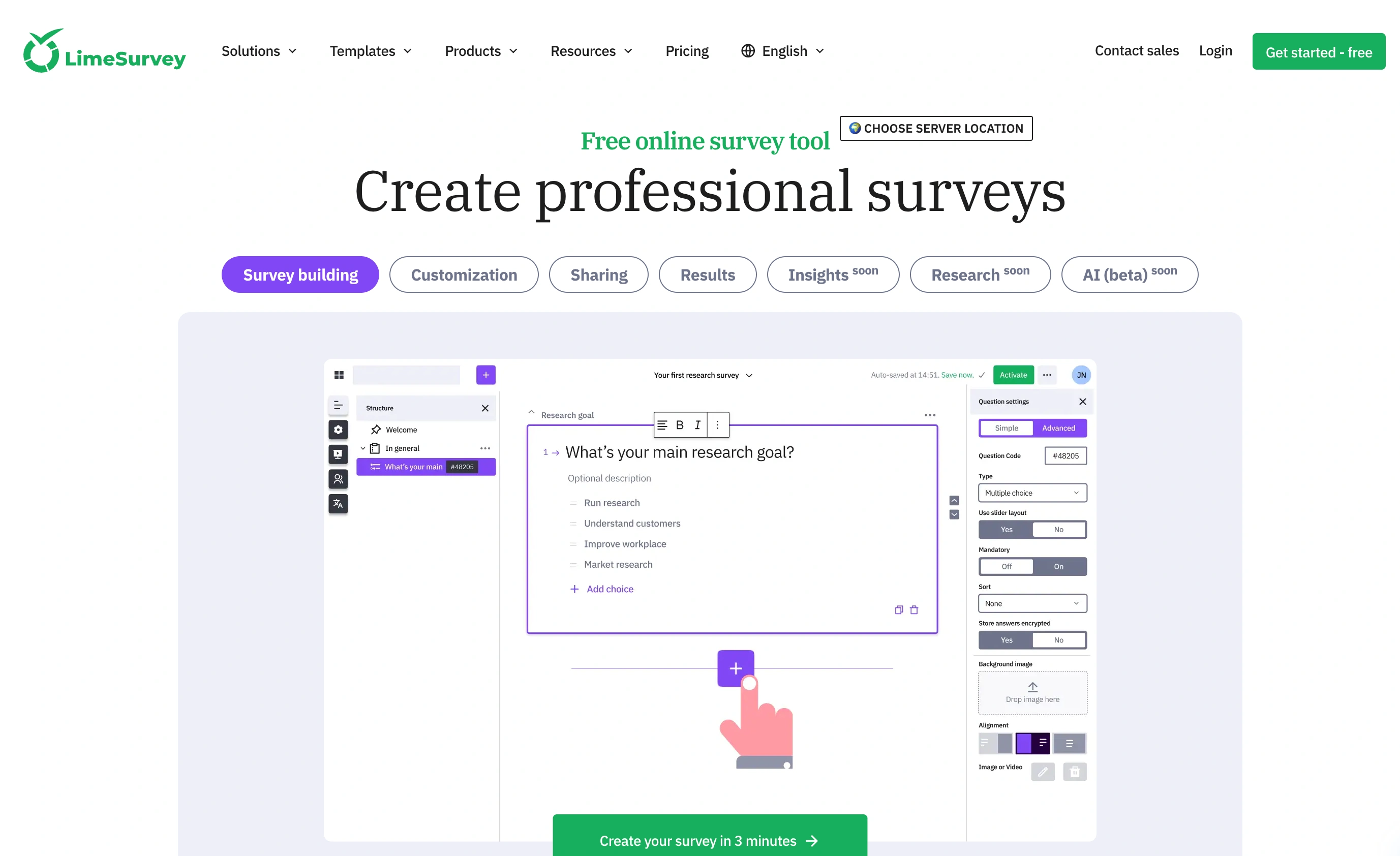
Cloud pricing is in euros and the units deserve close reading. The free tier allows 25 responses a month, which is a demo, not a plan. Basic is 26 EUR a month for 1,000 responses per month. The annual Expert and Business tiers meter responses per year, not per month, so compare carefully before assuming one is cheaper.
Honest limitation: the admin interface and the respondent-facing forms both look their age. Fine for a research panel, hard to put in front of customers next to a modern brand.
6. Form.io — the developer platform
Form.io is not a form builder app; it’s a headless form API server (Node.js plus MongoDB) where forms are JSON schemas rendered inside your own application. The open source server is OSL-3.0 licensed and actively tagged, most recently in July 2026. If you’re embedding complex forms into a product you’re building, this architecture is genuinely the right shape.
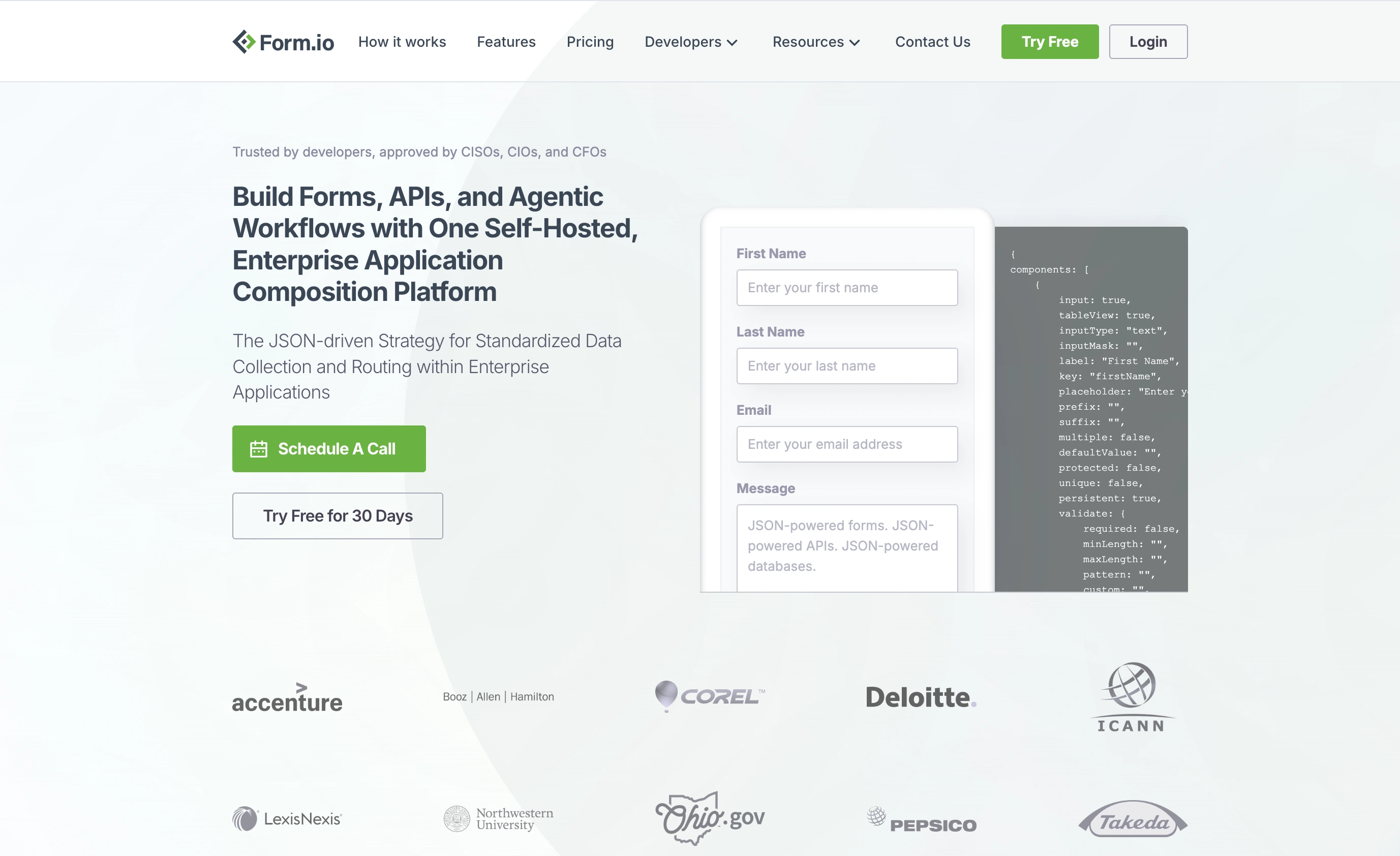
The commercial side is priced for enterprises: no free tier, a 30-day trial, then $300 a month for SaaS or $330 a month per environment for the self-hosted enterprise API server.
Honest limitation: there’s no end-user app here. Without a developer on staff, Form.io isn’t usable at all.
The migration cost nobody prices in
Whichever way you go, switching form tools has a fixed cost that the pricing pages skip. Every form gets rebuilt by hand, because no two builders share a schema. Every embed and shared link changes, so anything printed on a QR code or buried in an old email campaign breaks. And historical responses usually travel as a CSV export, disconnected from the new tool’s analytics.
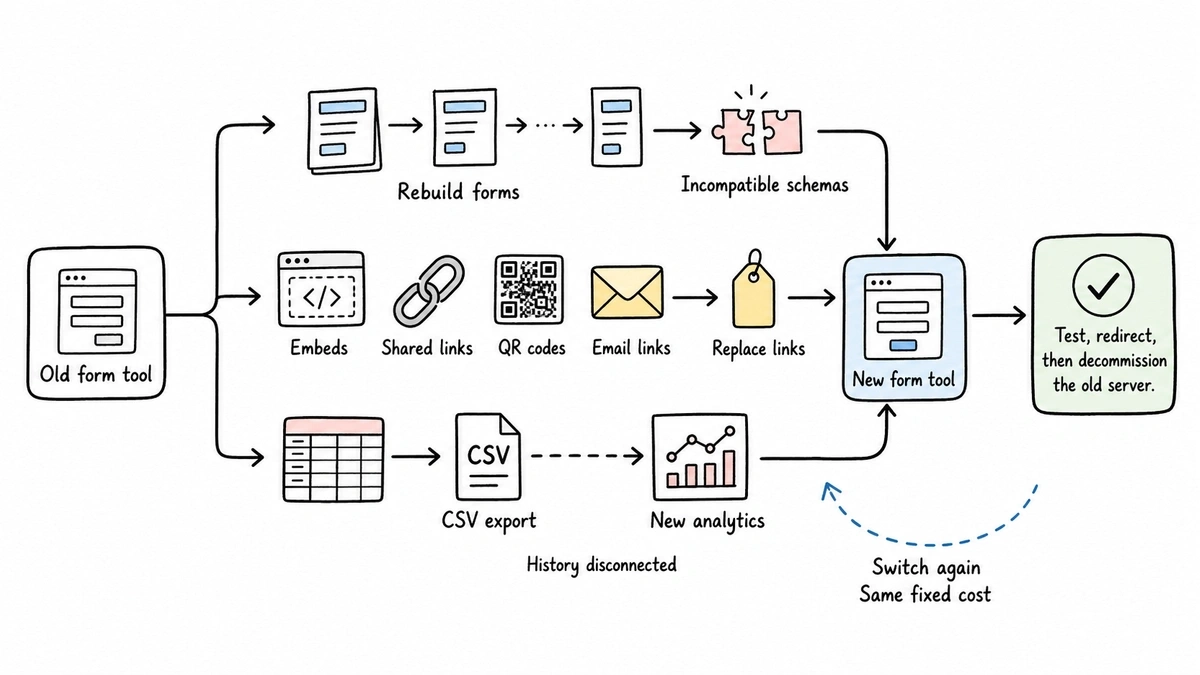
That cost lands twice if you self-host, migrate away, and then have to decommission the server too. It’s a reason to make this choice once, deliberately, rather than hopping annually.
If your real requirement was unlimited free responses
Here’s the honest fork in the road. If you need data on your own hardware for compliance or policy reasons, pick from the six above and stop reading. Nothing we sell solves that.
But a lot of people land on this search after hitting a response cap on a commercial tool, and self-hosting is the workaround, not the goal. If that’s you, we built Fomr as a free form builder for exactly that case: unlimited forms, responses, fields, and team members on the free plan, with no server to patch on a Sunday. You get a visual drag-and-drop editor, 1,700+ fonts and full design control, and sharing via link, embed, popup, or QR code. Our Pro plan is $34/month or $24/month billed yearly for custom domains and removing our branding, and you can try the editor without creating an account.
Full disclosure on the gaps: payments and integrations like Zapier are still coming soon. OpnForm has all of those today. What we offer instead is zero operations and zero response limits, which is the trade this whole article has been about.
Give it a try
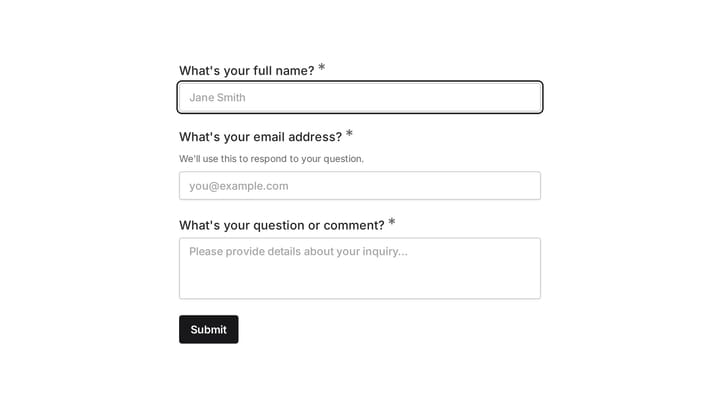
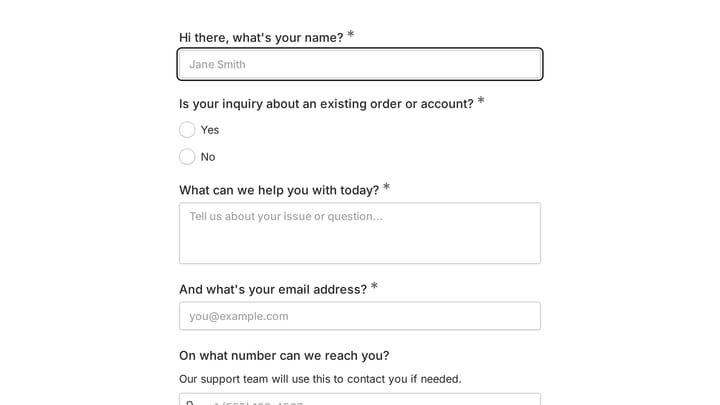
Try this Fomr contact form
This contact form shows the hosted Fomr option for readers who want free response collection without maintaining a server. Fomr is not open source and cannot be self-hosted.
The verdict
- Best overall open source form builder: OpnForm, as long as the 2-user self-hosted cap doesn’t bite you
- Budget pick: HeyForm, cheapest paid cloud at $15 a month, no free tier though
- Specialist picks: Formbricks for in-product surveys, Typebot for chat flows, LimeSurvey for research, Form.io if you’re a developer embedding forms in your own product
- The no-ops option: Fomr’s free plan, if unlimited responses were the point and the server never was
For a broader look beyond open source, our roundup of the best free online form builders covers the commercial side of the same decision.