Nobody shops for Gravity Forms alternatives in month two. The search almost always starts when the renewal email lands. You bought a Basic license at $59, then discovered that Stripe payments and Zapier need the $159 Pro tier, and surveys, signatures, and user registration sit behind the $259 Elite tier. Now the renewal is due and you’re doing the math on year three.
We checked the Gravity Forms pricing page the day we wrote this. The tiers are Basic at $59/year for one site, Pro at $159/year for three sites, and Elite at $259/year for unlimited sites and all add-ons. There’s no first-year discount right now, which cuts both ways: no bait-and-switch, but also no relief. You pay the sticker price every year, forever, and the add-on you need next always seems to live one tier up.
Before you renew, it’s worth knowing there are two genuinely different exits. You can switch to another WordPress plugin and keep your entries in your own database. Or you can leave WordPress entirely and embed a hosted form instead. Most alternatives lists mash these together. They’re different decisions with different trade-offs, so we’ve split the list.
Two kinds of Gravity Forms alternatives: stay or leave
Gravity Forms stores every submission in your WordPress database. That’s its quiet superpower. Your data sits on your server, your backups cover it, and plugins like GravityView can build entire applications on top of it.
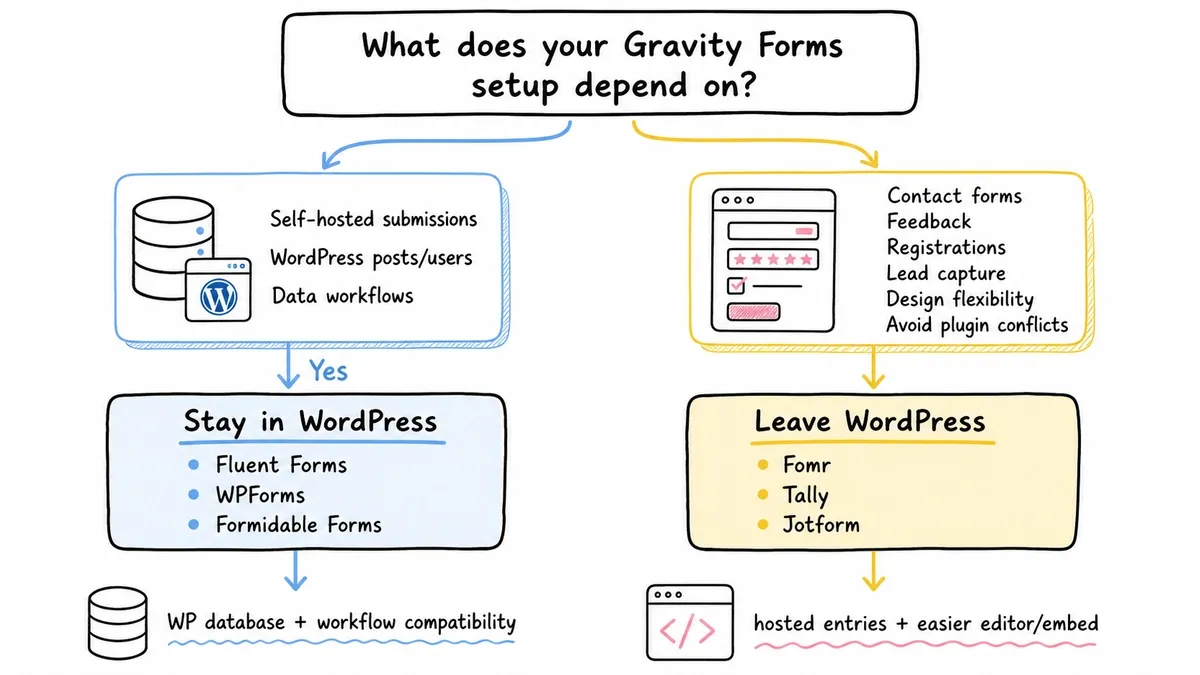
Stay in WordPress if you build workflows on entry data, need submissions to create posts or users, or have compliance reasons to self-host. Another plugin is your answer, and the good ones migrate your existing entries.
Leave WordPress if your forms are really just forms: contact, feedback, registrations, lead capture. A hosted builder gives you a better editor, a form that survives theme changes and plugin conflicts, and usually a far better free tier. The cost is real, though, and we’ll spell it out below.
Here’s the list. Three picks for each camp.
Give it a try
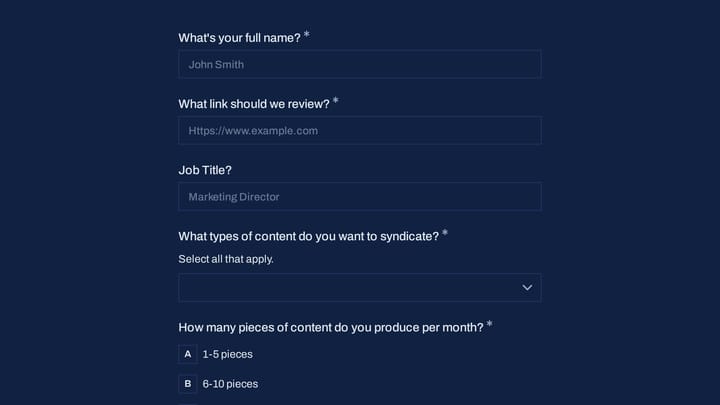
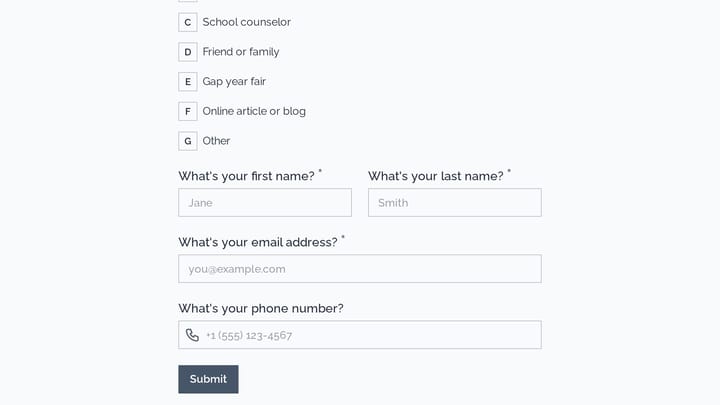
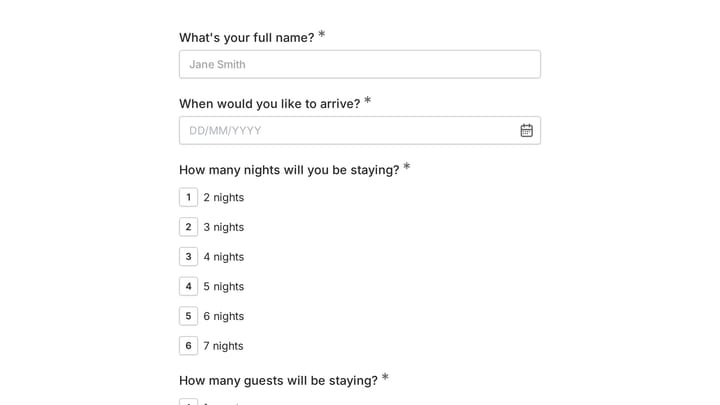
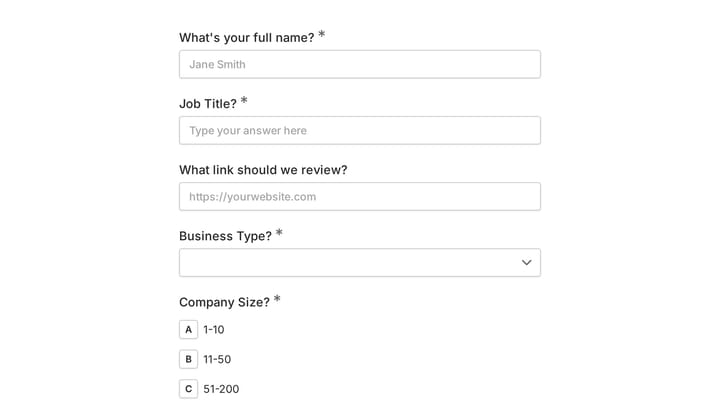
Give this web project intake questionnaire a spin
This is a real, working template from our gallery. Fill it out like a respondent would, then make it your own.

Staying in WordPress
1. Fluent Forms — best value if you’re staying
Fluent Forms is the pick we’d make for most Gravity Forms refugees, and the reason is structural: every license includes every feature. There is no add-on ladder. Payments, conversational forms, quizzes, and the integration stack come with the $55/year single-site license, which undercuts even Gravity Forms Basic while matching most of Elite.
The migration story is the other reason it tops this list. The built-in migrator imports your Gravity Forms forms and their entries, so you don’t abandon years of submission history. That’s rarer than it should be.
The honest limitation: the ecosystem is smaller. Gravity Forms has fifteen years of third-party add-ons and developer mindshare. If your setup depends on something like GravityView or a niche certified add-on, check for an equivalent before you commit.
Pricing: Free core plugin on WordPress.org. Pro is $55/year for one site, $111/year for five, $209/year for unlimited. Lifetime licenses start at $279.
2. WPForms — most polished editor in the WordPress camp
WPForms is the biggest name in WordPress forms and the editor shows why. It’s a true drag-and-drop builder with a live preview, which still isn’t something Gravity Forms offers natively. Its importer detects Gravity Forms and brings over both forms and entries (entry import needs a Pro license).
The pricing needs a careful read. The advertised prices are 50% off for the first year: Basic at $49.50, Plus at $99.50, Pro at $199.50, Elite at $299.50. Renewals revert to full price, so Pro, the tier where payments, Zapier, and surveys live, costs $399/year from year two. That’s more than Gravity Forms Elite. If renewal cost triggered your search, WPForms may recreate the exact problem in twelve months, just with a nicer editor.
Pricing: $49.50 to $299.50 first year, $99 to $599/year on renewal. Free Lite version exists but is heavily limited.
3. Formidable Forms — for data-heavy sites and calculators
Formidable is the specialist pick. Its Views feature turns submissions into front-end tables, calendars, and directories, which makes it the closest thing to the Gravity Forms + GravityView combo in a single plugin. If you’ve been using Gravity Forms to build an actual application (member directories, quote calculators, job boards), Formidable is the alternative that takes that use case most seriously.
Migration is weaker than Fluent Forms: there’s a Gravity Forms importer for form structures, but entries typically come across via CSV export and import rather than one click. Budget an afternoon.
Pricing follows the same first-year-discount pattern as WPForms. Basic is $39.50 for year one (renews at $79), and the tiers step up to Elite at $299.50 first year ($599 on renewal). Notably, even Basic includes unlimited forms and entries plus payment collection.
Pricing: $39.50 to $299.50 first year, $79 to $599/year on renewal.
Leaving WordPress
4. Fomr — best if design is why you’re leaving
We build Fomr, so weigh this section accordingly. But there’s a specific Gravity Forms frustration we hear constantly: the forms look like your theme decided they should, and restyling them means fighting CSS. Fomr starts from the opposite end. You design the form visually, with 1,700+ fonts, full color and background control, and multi-page layouts, and it looks identical on every site you put it on.
The free plan has no caps: unlimited forms, responses, fields, and team members. Against a $259/year Elite renewal, that’s a serious number. You can embed forms on your WordPress site with a lightweight JavaScript widget, share a direct link, or use a QR code. If you want to feel the editor first, the guest editor works without an account.
Now the honest part. Fomr doesn’t have conditional logic, payments, or Zapier-style integrations yet (all are on the roadmap). And there is no entry migration: your existing Gravity Forms entries stay in WordPress, and new submissions live in Fomr, not your database. If your forms are simple and design-sensitive, that trade is worth it. If they’re workflow machines, it isn’t yet.
Pricing: Free with unlimited everything. Pro is $17/month for custom domains and removing our branding.
5. Tally — best free replacement for power users
Tally’s free plan is the most generous in the hosted category: unlimited forms and submissions, with conditional logic, calculations, file uploads, payment collection, and native integrations (Google Sheets, Notion, Zapier, webhooks) all included. For a solo builder replacing a Gravity Forms Pro license, that’s a remarkable amount of ground covered at $0.
The Notion-style editor is fast once it clicks, though people who love drag-and-drop sometimes find the type-to-build approach odd for the first hour. Pro at $24/month (cheaper paid yearly) mainly buys branding removal, custom domains, and analytics, and a Business tier sits at $74/month. As with any hosted tool, entries live on Tally’s servers, and there’s no Gravity Forms entry import.
Pricing: Free for unlimited forms and submissions. Pro $24/month, Business $74/month.
6. Jotform — best integration coverage outside WordPress
Jotform is the volume player: thousands of templates, a huge integration directory, payments on every plan, and approval workflows that replicate a lot of what people bolt onto Gravity Forms with add-ons. If your reason for leaving is “I need my form talking to everything,” Jotform has the broadest surface area of any hosted builder.
The free plan is tight at 5 forms and 100 submissions a month, and paid tiers are monthly SaaS pricing rather than an annual license: Bronze at $34/month billed annually, Silver at $39/month, Gold at $99/month with HIPAA features included. Over a year, even Bronze costs more than a Gravity Forms Elite license, so this is a switch you make for capability, not savings. Entries can be imported into Jotform tables via CSV, but there’s no dedicated Gravity Forms migrator.
Pricing: Free (5 forms, 100 submissions/month). Bronze $34, Silver $39, Gold $99 per month billed annually. Enterprise is custom.
What breaks when you leave WordPress
This is the part alternatives lists skip. If you replace Gravity Forms with any hosted builder, ours included:
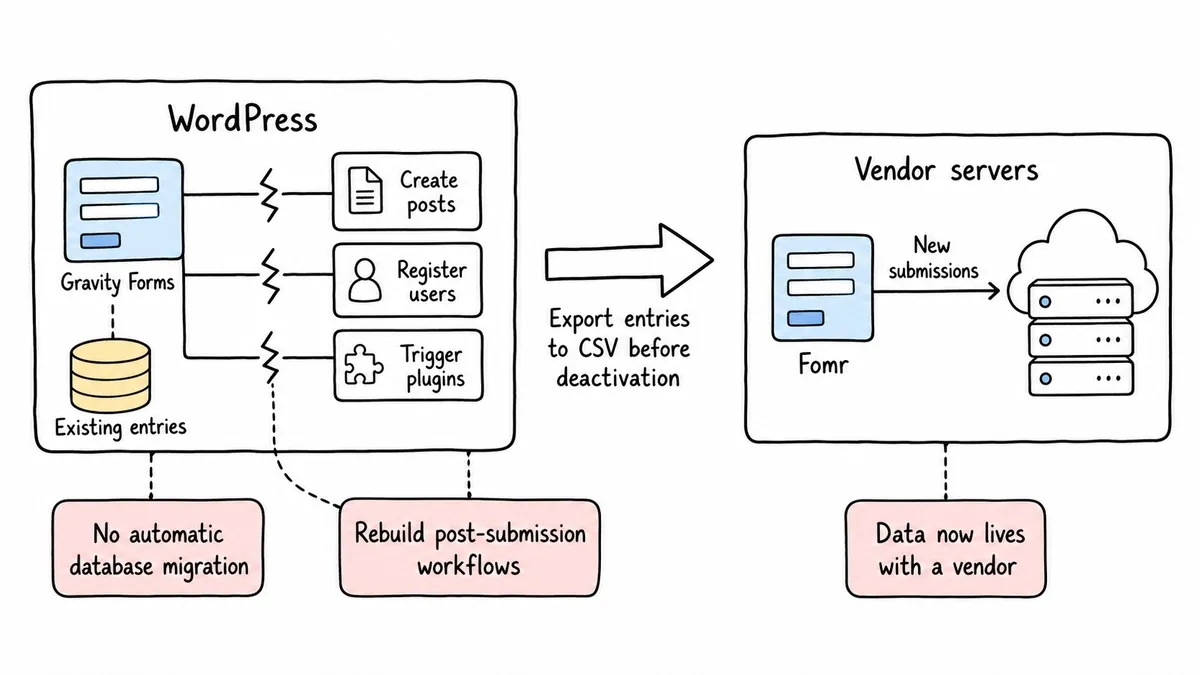
- Your existing entries stay behind. Export them to CSV before you deactivate anything, because nothing hosted imports the WordPress database automatically.
- Post-submission WordPress actions die. Forms that created posts, registered users, or triggered other plugins need those workflows rebuilt elsewhere, or they’re gone.
- Your data lives with a vendor. For most contact forms that’s fine, and hosted vendors often have stronger security practices than a neglected WP install. But if self-hosting was a requirement, it still is.
None of this is a reason to stay by default. It’s a checklist to run before you cancel the renewal.
Gravity Forms alternatives compared
| Tool | Yearly cost (realistic) | Free tier | Entries in your WP database | Imports GF entries |
|---|---|---|---|---|
| Gravity Forms | $59–$259/year | No | Yes | — |
| Fluent Forms | $55–$209/year | Yes (core plugin) | Yes | Yes, built-in migrator |
| WPForms | $99–$599/year after year one | Yes (Lite) | Yes | Yes (Pro license) |
| Formidable Forms | $79–$599/year after year one | Yes (Lite) | Yes | Forms yes, entries via CSV |
| Fomr | $0, Pro $204/year | Yes, unlimited | No | No |
| Tally | $0, Pro $288/year | Yes, unlimited | No | No |
| Jotform | $408–$1,188/year | Yes (5 forms, 100 subs/mo) | No | CSV only |
Prices checked against each vendor’s pricing page in August 2026. The WordPress plugins renew at full price; treat first-year discounts as marketing, not your budget.
The verdict
Staying in WordPress? Fluent Forms is the best overall swap: cheaper than your current license, no add-on ladder, and it brings your entries with it. Pick Formidable instead if you’re building data applications, and WPForms only if the editor matters more to you than the year-two renewal.
Leaving WordPress? Tally is the strongest free all-rounder today, and Jotform wins if integration breadth is the whole point. If what pushed you out was how your forms look, that’s the problem Fomr exists to solve, and the free plan means trying it costs nothing but an afternoon. Build one in the guest editor, embed it next to your current Gravity Form, and compare.
For the wider WordPress picture, we’ve also written up the best form builders for WordPress and a head-to-head of Gravity Forms vs WPForms.